The government changed a rule, and the media loudly got it wrong.
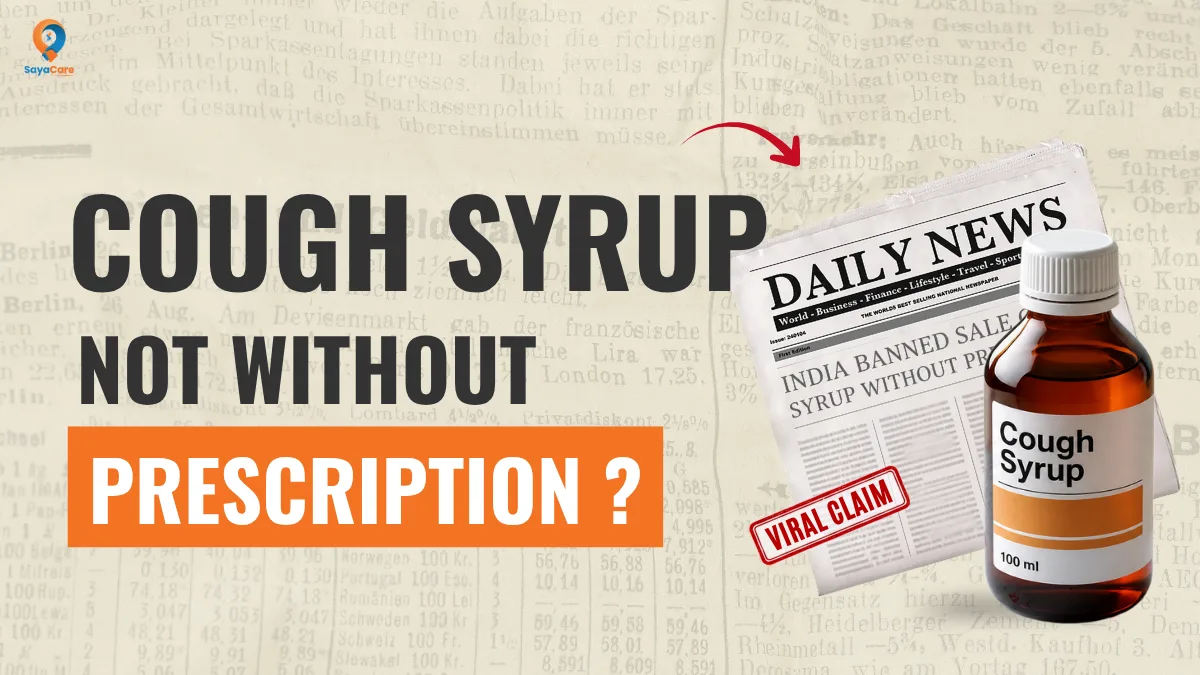
On June 16, 2026, the Ministry of Health and Family Welfare issued a press note stating that the word “syrup” has been omitted from Schedule K. Within hours, headlines were declaring that cough syrups are no longer available over the counter. Some went further, linking the amendment directly to the 2025 cough syrup tragedy in Madhya Pradesh and Rajasthan.
But a closer reading of the press release tells a different story. To begin with, the amendment says nothing exclusively about cough syrups. It is about all allopathic syrups (ex. Cough syrup, fever syrup and multivitamins syrups). And the implications of that are worth understanding properly.
Here is what the ministry actually said and what it means.
Table of Contents
The Current Status
The Ministry of Health and Family Welfare has omitted the word syrup from Schedule K.
In practice this meant that in smaller towns and villages, allopathic syrups could be sold at unregistered pharmacies without any oversight.
With syrups removed from that exemption, every allopathic syrup must now be sold only at a registered pharmacy regardless of location.
This amendment does not make syrups prescription only. It simply brings their sale under tighter watch by requiring all allopathic syrups whether for cough, fever, urinary tract infections or any other condition to be sold by registered pharmacies.
In urban areas this change will barely be felt. But for rural and small village areas, it is a meaningful shift in how these medicines are distributed and monitored.
This amendment also connects to an earlier government directive making it mandatory for manufacturers to test for diethylene glycol and ethylene glycol before a syrup is cleared for market, reflecting a broader ongoing effort to strengthen syrup regulation in India.
The question that follows is what the real world impact of this…….
The Impact
1. Curbing Misuse
Many syrups, particularly cough syrups, have sedative properties that have been misused widely. When dispensed by a registered pharmacist who is accountable and traceable, that misuse becomes harder to get away with and easier to track.
2. Controlled Regulation and Distribution
With allopathic syrups now restricted to registered pharmacies, drug inspectors have a clearer and more manageable system to work with. Registered pharmacies are required to maintain a log of every medicine they stock and sell, which means there is now a traceable record that authorities can check and act on.
3. Better Storage Condition
Syrups are more sensitive to heat and temperature than tablets and require controlled storage conditions. Unregistered outlets rarely have these in place. Beyond the obvious quality concern, there is a chemical risk too. Polyethylene glycol, commonly known as PEG, is used as an excipient in many syrups. When stored in poor conditions it can degrade and convert into diethylene glycol (DEG), the same chemical that has been linked to multiple syrup tragedies in India. Keeping syrups within registered pharmacies significantly reduces that risk.
Limitation of This Rule
While this amendment covers all allopathic syrups and is not exclusively about cough syrups, the cough syrup tragedies in India remain the most documented evidence of what happens when syrup regulation fails.
Looking at those cases helps understand where this amendment still falls short:
1. No Assurance of Quality
This amendment focuses on where syrups are sold, not what is inside them. A registered pharmacy can still stock a substandard or adulterated syrup. Several past syrup tragedies involved medicines that passed through legitimate channels, highlighting that manufacturing quality remains a separate challenge.
2. Location Does Not Tell the Full Story
The amendment appears designed to bring accountability to smaller, less regulated areas. But the previous cough syrup tragedy cases do not support the assumption that the problem is rural. Across 6 documented cough syrup tragedy cases in India, the victims came from both villages and urban areas. The geography was mixed.
Restricting sale to registered pharmacies does not address what happens before someone reaches the pharmacy. A large number of people in both urban and rural areas skip the doctor entirely and walk straight to the chemist counter asking for a syrup by name.
4. Hamper Accessibility
Not every syrup is a cough syrup bought on impulse. Iron syrups and multivitamins are a daily necessity for many women, especially during pregnancy. Fever, allergy and appetite syrups are things parents reach for regularly for their children. Restricting all of these to registered pharmacies in areas where such pharmacies are scarce creates a real accessibility problem for the people who need them most. For this gap, e-pharmacies can step in, bringing the same accountability this amendment demands without the barrier of physical distance.
Final Note
It is also worth noting that all 6 previous cough syrup cases were linked to people from lower socioeconomic backgrounds, and in most of those cases the medicine had actually been prescribed by a doctor. The failure was not at the prescription stage. The question that remains unanswered by this amendment is what went wrong at the manufacturing level, where the quality checks failed and why the safety standards were not enforced.
The regulation of who sells a syrup has now been tightened, but the accountability of who makes it and what goes into it remains as unclear as it was before. Until the laxity at the manufacturing level is addressed directly, this amendment may improve the distribution of syrups but for overall public health safety, it does not change much.
Mahak Phartyal completed her bachelor's in pharmacy from Veer Madho Singh Bhandari Uttarakhand Technical University. She previously worked as a Medical Writer at Meril Life Sciences, where she wrote numerous scientific abstracts for conferences such as India Live 2024 and the European Society of Cardiology (ESC). During her college years, she developed a keen research interest and published an article titled “Preliminary Phytochemical Screening, Physicochemical and Fluorescence Analysis of Nyctanthes arbor-tristis and Syzygium cumini Leaves.”
Mahak Phartyal completed her bachelor’s in pharmacy from Veer Madho Singh Bhandari Uttarakhand Technical University. She previously worked as a Medical Writer at Meril Life Sciences, where she wrote numerous scientific abstracts for conferences such as India Live 2024 and the European Society of Cardiology (ESC). During her college years, she developed a keen research interest and published an article titled “Preliminary Phytochemical Screening, Physicochemical and Fluorescence Analysis of Nyctanthes arbor-tristis and Syzygium cumini Leaves.”
1 thought on “Can You Still Buy Cough Syrup Without a Prescription? ”
Govt. Should check all medicines at Manufacturing place & then NOC should be allowed to supply in market. For Duplicate, substandard Adulterated drugs Acts must be ammended to bring under criminal law






Govt. Should check all medicines at Manufacturing place & then NOC should be allowed to supply in market. For Duplicate, substandard Adulterated drugs Acts must be ammended to bring under criminal law