Every medicine sold in India carries a label. That label lists ingredients, dosage, and a manufacturer’s name. But what it does not tell you is whether what is inside the strip actually matches what is printed on it. That is exactly what a medicine test report is meant to verify.
A 2025 study by the Authentication Solution Providers Association (ASPA) found that nearly 28% of India’s pharmaceutical market consists of substandard or counterfeit medicines. Several branded medicines, regularly prescribed by doctors across the country, have been flagged by CDSCO as failing quality standards. A substandard medicine does not just fail to heal, it can even make the condition worse.
Despite this, medicine purchases in India run almost entirely on brand trust, a trust built through marketing rather than any publicly available quality data.
SayaCare was built to change that. Every medicine listed on the platform is tested by a third party NABL certified lab before it goes live, and the test report is made publicly visible with each batch. Because every Indian deserves to know what they are taking, and that change has to start somewhere.
This blog breaks down how to read a medicine test report in simple, easy to understand language.
Table of Contents
What to Check in a Medicine Test Report?
A medicine test report is not just a document full of numbers and technical terms. Every line in it is answering a specific question about what is actually inside that tablet or capsule.
Is it pure?
Does it contain what it claims to?
Are there harmful substances present?
Are all the ingredients in the right quantity?
Each test in the report answers one of these, and together they tell you the full story before the medicine ever reaches you.
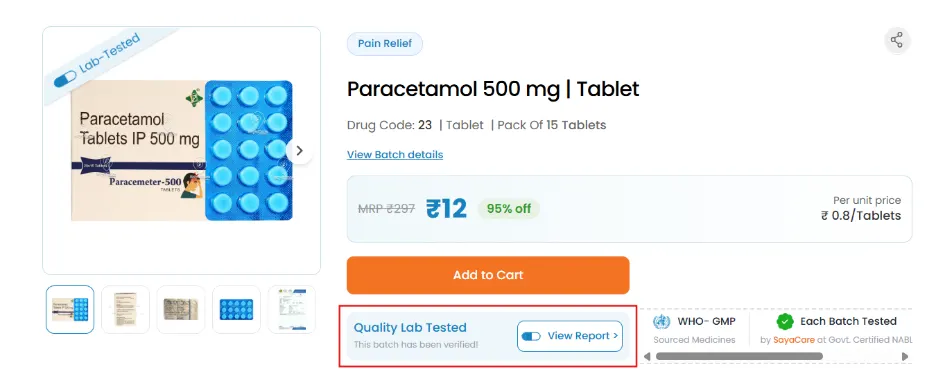
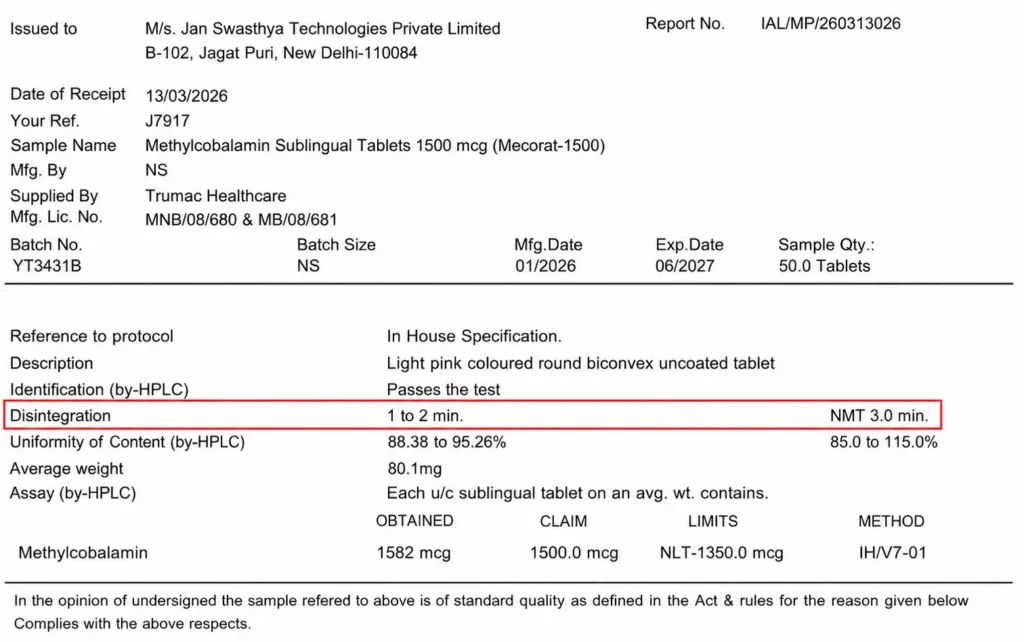
When you click on “View Test Report” for any product on SayaCare’s website, a report will open up. Here is what each part means and how to read this medicine test report:
Following are the Test You should check to Know the Medicine Quality:
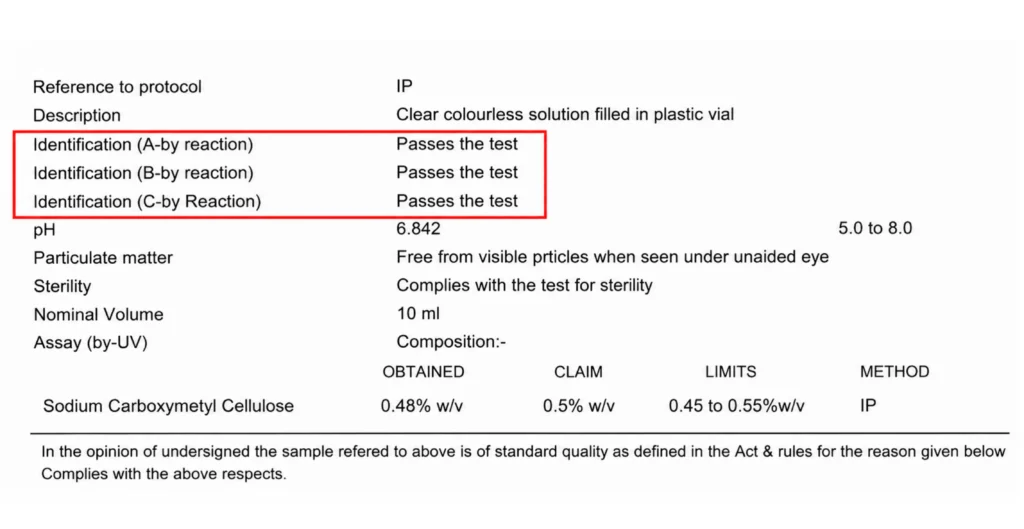
1. What’s Inside Your Medicine- Identification Test
Imagine you are looking for someone you know well in a crowd of people who all look similar. How do you find them? You ask questions, and based on the answers you figure out who is who.
This medicine test works the same way. Many medicines look identical from the outside, and even the same salt can appear in multiple brands with nothing to distinguish them visually. So to confirm that a medicine is actually what its label claims to be, a set of chemical reactions are run on it. If the medicine responds correctly to all of them, it confirms the identity. If it doesn’t, something is wrong.
That is what the identification test is. Next time you open a medicine test report, look for this first.
2. Strength of Your Medicine- Assay Testing:
Once you know the medicine is what it claims to be, the next question is whether it contains the right amount of it.
The assay test measures the quantity and concentration of the active ingredient inside the medicine. This number is then compared against what the label claims and the accepted limits set for that particular ingredient. Too little and the medicine won’t work. Too much and it can cause harm.
This medicine test that tells you whether the medicine you are taking is actually strong enough to do its job.
The two tests above are mandatory for every medicine. The ones that follow will vary depending on the formulation of the medicine.
Test For Tablet:
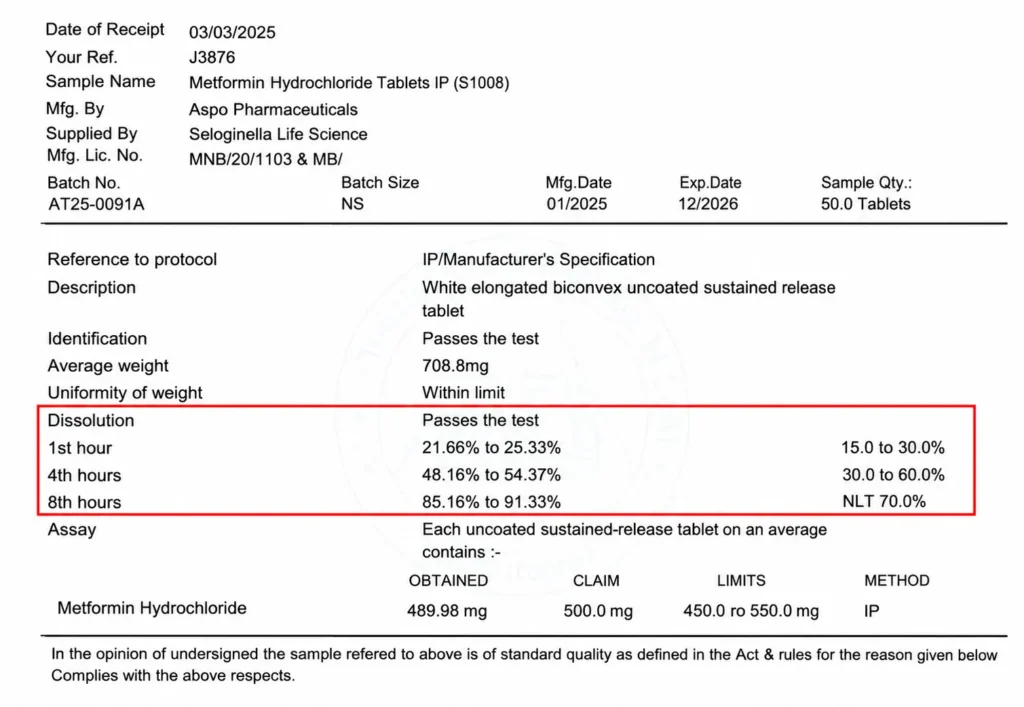
1. How Fast Your Medicine Breaks and Dissolves- Dissolution and Disintegration Test:
Not every tablet works the same way inside your body, and this medicine test accounts for that difference.
Some tablets like extended release, prolonged release, or controlled release medicines are designed to dissolve slowly. They are swallowed whole and gradually release the active ingredient as body fluids break them down over time. For these, the dissolution test tracks how much of the medicine has dissolved at specific intervals, typically measured at 1 hour, 4 hours, and 8 hours, to make sure it is releasing at the right pace.
Immediate release medicines are tested for dissolution too, but for the opposite reason. Here the test confirms that the medicine dissolves quickly enough to act fast when the body needs it.
Other medicines work differently altogether. Sublingual tablets are placed under the tongue and need to act almost instantly. For these, the disintegration test checks how quickly the tablet breaks apart the moment it comes into contact with moisture.
So depending on what kind of medicine you are looking at, this medicine test tells you whether it is releasing too fast, too slow, or exactly as it should.
2. Average Weight
Every tablet has a defined weight, and that number matters more than it sounds. If a tablet weighs less than what the label claims, it likely contains less of the active ingredient than it should. And a medicine with less active ingredient than required simply will not work the way it is supposed to.
3. Uniformity of Weight
Knowing the average weight of a batch is one thing, but what about each individual tablet within that batch? This medicine test checks whether every single tablet stays close to that average. Because even if the batch average looks fine, a tablet that is significantly lighter or heavier than the rest is a problem.
4. Uniformity of Content
This goes one step further. While uniformity of weight checks the physical weight of each tablet, this test checks whether each tablet actually contains the correct amount of active ingredient. A tablet can weigh right and still have an uneven distribution of the active ingredient inside it. This test makes sure that does not happen.
Tests For Syrups
1. Ethylene and Diethylene Glycol Test
In 2025, 23 children in Madhya Pradesh and Rajasthan lost their lives after consuming cough syrups that were contaminated with diethylene glycol, a chemical commonly used in brake fluid. It causes kidney failure, and it has no place anywhere near a medicine.
Following that tragedy, the government made it mandatory to test all cough syrups for the presence of ethylene glycol and diethylene glycol before they can be sold. This test is that check. When you see it on a cough syrup’s medicine test report, it means the medicine has been verified to be free of these harmful chemicals.
Average Fill Volume
For liquid medicines, this test measures the actual average volume obtained when a sample of units from the batch is tested. It confirms that what is filled in the bottle matches what the label says you are getting.
Tests For Nasal Drops and Eye Drop
1. pH
Different parts of your body have their own natural pH levels. The eyes sit at around 7 to 7.4 while the nasal passage is more acidic at around 5.6. Any medicine that goes into these areas, whether eye drops or nasal sprays, needs to match that pH closely. If it is even slightly off, it can irritate or damage the tissue it comes into contact with. This test confirms that the medicine’s pH falls within the acceptable range for safe use.
Heavy Metal Testing
Heavy metals like lead, arsenic, and mercury have no place in a medicine, and testing for them is an important safety check. However, the pharmacopoeia, which is the official reference that defines testing standards for medicines, currently only mandates heavy metal testing for a specific set of drugs, not for all medicines across the board.
Because of this, SayaCare currently does not conduct heavy metal testing for every medicine and therefore is not present in our medicine test report. As those standards expand, so will the testing.
Indians are rightly cautious about fake paneer, fake honey, fake milk. People check, question, and demand better because they know what they eat affects their health.
But somehow, that same caution rarely extends to medicines.
A substandard medicine is no different from adulterated food. It enters your body, and if it is not what it claims to be, it does not just fail to help, it can quietly make things worse. The difference is that with food, the effects are often immediate and visible. With medicine, you might never connect the dots.
And this is a reason to be aware.
SayaCare’s medicine test reports exist for exactly that purpose. Not to overwhelm you with numbers, but to give you proof, that every batch is tested, and every report is visible.
Stop paying more for a brand that offers you nothing but a name. Start trusting what has actually been tested.
SayaCare is the First Online Pharmacy to Give Quality Test Report with Each Batch.
Mahak Phartyal completed her bachelor's in pharmacy from Veer Madho Singh Bhandari Uttarakhand Technical University. She previously worked as a Medical Writer at Meril Life Sciences, where she wrote numerous scientific abstracts for conferences such as India Live 2024 and the European Society of Cardiology (ESC). During her college years, she developed a keen research interest and published an article titled “Preliminary Phytochemical Screening, Physicochemical and Fluorescence Analysis of Nyctanthes arbor-tristis and Syzygium cumini Leaves.”
Mahak Phartyal completed her bachelor’s in pharmacy from Veer Madho Singh Bhandari Uttarakhand Technical University. She previously worked as a Medical Writer at Meril Life Sciences, where she wrote numerous scientific abstracts for conferences such as India Live 2024 and the European Society of Cardiology (ESC). During her college years, she developed a keen research interest and published an article titled “Preliminary Phytochemical Screening, Physicochemical and Fluorescence Analysis of Nyctanthes arbor-tristis and Syzygium cumini Leaves.”