When Reliance Jio offered free, unlimited data for four months, video calls, streaming, and social media stopped being occasional luxuries and became daily habits. What followed was a price war so intense that every major telecom operator was forced to slash rates just to survive. This clash paved the way for unlimited blue light exposure for millions of Indians.
Today, India has more than 780 million internet users, spending an average of 7.3 hours a day on their phones which is more than users in the US or China. The economic upside of this shift is well documented: connectivity, access, and scale at a price few countries can match.
But the biological cost of this always-on screen culture has received far less attention.
Smartphone screens emit high-energy blue light. Prolonged exposure to it doesn’t just cause temporary eye strain; it interferes with sleep cycles, disrupts tear production, and places sustained stress on eye cells. As screen exposure becomes unavoidable, knowing how to protect the eyes from prolonged blue light exposure may matter more than most people realise. Read to know more.
Table of Contents
What is Blue Light?
Ever wondered why the sun feels warm despite being so far away ? The answer lies in sunlight .
Sunlight carries energy in the form of tiny moving particles called photons. When these energy-filled photons reach your skin, you feel the warmth of the sun. You can sense energy in front of any light source, whether it’s a bulb or a light tube. The intensity may be lower, but the energy is still present.
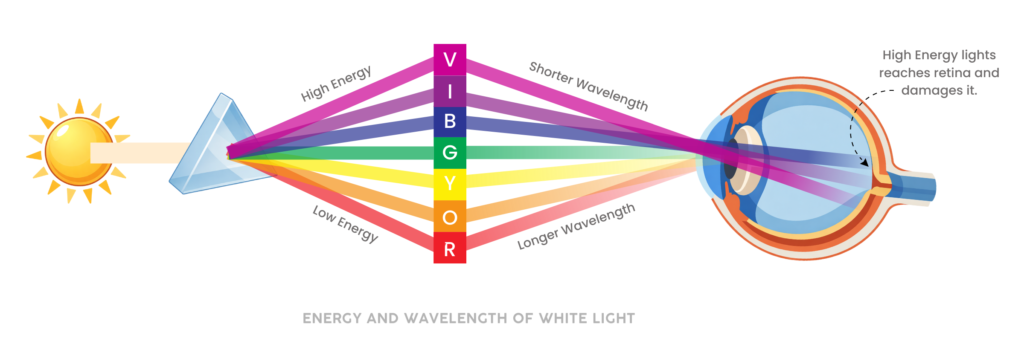
White light isn’t actually white at all. It is made up of the seven colors of the rainbow, together known as VIBGYOR : Violet, indigo, blue, green yellow, orange and red.
White light spans a spectrum of colors, from red to violet. As the colors move towards the violet edge of the rainbow, the energy carried by the light increases, peaking at the violet end of the visible spectrum .
Image of white light splitting into a rainbow, showing the wavelength and energy of each color.
Studies have identified the blue–indigo region of the visible spectrum, roughly between 440 and 460 nm, as the range most closely associated with eye damage from prolonged exposure. This raises an important Question. How does a rainbow affect our eyes? This is what takes us to the next question that is………….
How Does Blue Light Damages our Eyes?
Different wavelengths of light interact with eye in different ways. The higher energy light only partially absorbed by the cornea (the outermost protective layer of the eye). The remaining light penetrates deeper, reaching the retina (region where image is formed) and it is here that prolong exposure can cause damage.
Blue light carries high energy. When it repeatedly strikes the retina, it causes what is known as photochemical damage. In simple terms, the light triggers chemical reactions inside retinal cells. Over time, these reactions can damage or even kill the cells. As more cells are affected, vision can begin to deteriorate earlier than it should.
Impact of Blue Light on Eyes
Prolonged exposure to blue light affects the body in following ways:
1- Sleep Disorder
Light enters the eyes and suppresses the production of melatonin, the hormone that signals the body to prepare for sleep. Reduced melatonin levels keep the brain alert, delaying sleep onset and disrupting the natural sleep-wake cycle. Over time, this leads to difficulty falling asleep, poorer sleep quality and frequent night time awakening, one reason health experts advise limiting the use of phones before bedtime.
2- Dry Eye and Digital Eye Strain
Prolonged screen use is closely linked to both dry eye and digital eye strain. Staring at screens reduces the frequency of blinking, or may often lead to incomplete blinking. This causes tears to evaporate faster than normal. This results in dryness, irritation, and discomfort in the eyes.
The data reflects this trend. In a study conducted at an Indian University involving 345 students, 45.5% reported experiencing digital eye strain. Another study of 422 undergraduate students, found that 22.9% showed signs of dry eye syndrome. Both studies also noted that higher screen time was associated with poorer sleep quality.
How Can I Protect Myself From Blue Light
1- The 20-20-20 Rule
For people who spend long hours in front of screens, reducing screen time is often unrealistic. Instead, eye specialists recommend the 20-20-20 rule: every 20 minutes, look at an object at least 20 feet aways for 20 seconds. These brief breaks help relax the eye muscles and reduce the continuous strain caused by prolonged screen exposure.
2- Lubricating Eye Drops
People who work on screens for long hours often experience dryness and irritation. One reason is reduced or incomplete blinking. Using lubricating eye drops can help maintain moisture and reduce discomfort. Eye drops containing carboxymethylcellulose are commonly used for this purpose and are easily available at medical stores.
3- Use Blue Cut Lens
Blue-cut lenses reduces exposure to high-energy blue light, helping lower retina strain during prolonged screen use.
These steps are small but sticking to them consistently is the real challenge.
Conclusion
Blue light strains the eyes, disrupts sleep, and accelerates dryness. Protecting the eye dose not require drastic changes but consistent habits: the 20-20-20 rule, blue cut lens and lubricating eye drops. What we see as color is simply the brain’s way of interpreting different wavelengths, a built-in warning system for energy levels.
Color isn’t actually there. It’s something our brain came up with to differentiate waves of light – that differentiation is your brain warning you (it) to protect yourself (itself).
Mahak Phartyal completed her bachelor's in pharmacy from Veer Madho Singh Bhandari Uttarakhand Technical University. She previously worked as a Medical Writer at Meril Life Sciences, where she wrote numerous scientific abstracts for conferences such as India Live 2024 and the European Society of Cardiology (ESC). During her college years, she developed a keen research interest and published an article titled “Preliminary Phytochemical Screening, Physicochemical and Fluorescence Analysis of Nyctanthes arbor-tristis and Syzygium cumini Leaves.”
Mahak Phartyal completed her bachelor’s in pharmacy from Veer Madho Singh Bhandari Uttarakhand Technical University. She previously worked as a Medical Writer at Meril Life Sciences, where she wrote numerous scientific abstracts for conferences such as India Live 2024 and the European Society of Cardiology (ESC). During her college years, she developed a keen research interest and published an article titled “Preliminary Phytochemical Screening, Physicochemical and Fluorescence Analysis of Nyctanthes arbor-tristis and Syzygium cumini Leaves.”