In late September and early October 2025, more than twenty-three children lost their lives after consuming cough syrup again. This was not the second incident. It was the sixth case reported in India. Doctors blamed the manufacturer, the manufacturer blamed the government and the government blamed parents for giving medicines on their own. The question now is whether any action was taken this time. What guarantee is there that a seventh or eighth tragedy will not follow. In this blog we explain what happened after the poisonous cough syrup incident and what people within the industry think about the decisions that followed. Read till the end to learn more.
Table of Contents
What is the 2025 Cough Syrup Tragedy?
The sixth cough syrup tragedy occurred in 2025, where more than twenty-three children died after consuming a cough syrup that contained dangerously high levels of diethylene glycol. This contaminant was the direct cause of the deaths. If you want to read the full story of the cough syrup tragedy, click here to know more.
What happened after the Cough Syrup Tragedy?
After the cough syrup incident, CDSCO issued an advisory asking drug inspectors to strictly follow Rule 74 (c), Rule 78 (c) (ii) and Schedule U of the Drugs and Cosmetics Rules, 1945.CDSCO advisory.
When I checked what these rules actually cover and why they were suddenly being mentioned, I found that they relate to conditions for licences, specifically, Form 25B (licence for repacking drugs for sale or distribution) and Forms 28, 28B, and 28D (conditions for granting manufacturing licences).
None of these rules address the detection of DEG or EG in cough syrups.
During our interview with one manufacturer, we asked why CDSCO issued such an advisory. He said, “It might be to control the immediate panic among people after the cough syrup tragedy.”
CDSCO also tested six batches of Coldrif and reported that the syrup was free from DEG. The Tamil Nadu government, however, reported that the same syrup contained DEG above the limit at 48%.
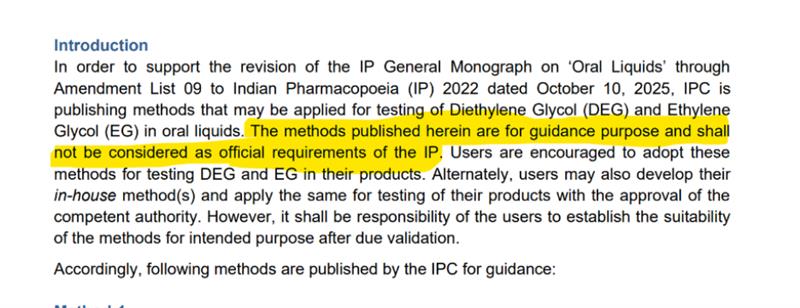
The next major step came from the Indian Pharmacopoeial Commission, an autonomous body under the Ministry of Health and Family Welfare. IPC released a guidance document and updated the liquid oral section of the Indian Pharmacopoeia to include DEG and EG testing through gas chromatography. The guidance document does not make the test mandatory.
Even so, manufacturers appear to be taking it very seriously, which is a good sign because it improves safety for everyone.
The third development relates to the updated Good Manufacturing Practices. These changes were not introduced only because of the cough syrup case. They were part of the broader updates announced in 2023.
The most important question now is how these changes will affect you. This brings us to the next section which is………
How will the New Rules Reform Impact You?
“These rules will barely affect the consumer’s pocket because testing one batch costs around 1300 rupees and if that amount is divided across each bottle the increase is very small,” said the head of an NABL laboratory.
This is the view from a third-party lab. A medicine manufacturer, however, gave a different picture. He said, “By the end of 2026 the price of cough syrup will definitely rise. Implementing the current GMP will cost around 2 to 3 crore rupees which is too much for small and medium manufacturers. They will either take loans or shift from medicine manufacturing to nutraceuticals. If they take loans they will recover the cost from the consumer.”
The real question is whether these rules, which are meant to ensure quality, will actually guarantee it. This leads us to the next section which is…
Will Indian Medicine Quality Get Better?
When asked whether these rules will actually be followed on the ground, or if manufacturers like Sreesan can simply bribe drug inspectors, the manufacturer said, “Bribing gives only short-term relief. Bribery is not limited to one district. If the medicine is supplied everywhere, they would have to bribe many people, which becomes a burden.”
This clearly shows that no one is fully sure whether the quality of medicines will improve. “There will always be a grey area in the rules and people often find ways to misuse them”- Medicine Manufacturer
When asked how a blacklisted company like Kayson can still supply medicines to government facilities, he said, “No big manufacturers participate in government tenders. There are many loopholes and it is a loss-making deal for them. That is why only local manufacturers take part and often supply low-quality medicines.”
When asked whether the government inspects manufacturing sites before finalising tenders, he said, “The government gives a self-declaration form. They do not check everything in detail.”
The important point here is that even if the government sets rules for cough syrup, there is no guarantee that unsafe medicine will not reach you. As seen in the Coldrif case, drug inspectors suspected DEG in the syrup, yet it was still available on the market.
Second, these rules apply only to syrups. There is no guarantee that the tablets, capsules or other medicines you consume are not fake. As the manufacturer said, “People need to be aware of fake medicines. People need to question the quality.”
Unless you take responsibility for your own health, no one else will. It is important to ask for test reports for whatever you consume before it risks your life. SayaCare is the only online pharmacy that provides a test report with every medicine you order. Because tested hai tabhi bharosa hai!!!!
Conclusion
The 2025 cough syrup tragedy has once again exposed the deep cracks in India’s drug quality system. Rules have been updated, advisories have been issued and testing methods have been added, but none of this is enough unless the changes work on the ground. Manufacturers say the cost of compliance will rise. Laboratories say the impact on consumers will be small. The truth lies somewhere in between.
What this tragedy makes clear is that trust cannot be built on assumptions. Government rules alone cannot guarantee safety. Manufacturers alone cannot guarantee safety. The responsibility also lies with every person who buys and consumes medicine. You must ask questions. You must check what you are taking. You must demand proof.
Safe medicine should never be a gamble and quality should never depend on luck. Until the system becomes stronger, the only protection you have is awareness and verified information. That is why choosing platforms that provide test reports with every order matters.
Your life depends on what you put in your mouth. Make sure it is tested. Make sure it is safe. Only then can you trust it.
Mahak Phartyal completed her bachelor's in pharmacy from Veer Madho Singh Bhandari Uttarakhand Technical University. She previously worked as a Medical Writer at Meril Life Sciences, where she wrote numerous scientific abstracts for conferences such as India Live 2024 and the European Society of Cardiology (ESC). During her college years, she developed a keen research interest and published an article titled “Preliminary Phytochemical Screening, Physicochemical and Fluorescence Analysis of Nyctanthes arbor-tristis and Syzygium cumini Leaves.”
Mahak Phartyal completed her bachelor’s in pharmacy from Veer Madho Singh Bhandari Uttarakhand Technical University. She previously worked as a Medical Writer at Meril Life Sciences, where she wrote numerous scientific abstracts for conferences such as India Live 2024 and the European Society of Cardiology (ESC). During her college years, she developed a keen research interest and published an article titled “Preliminary Phytochemical Screening, Physicochemical and Fluorescence Analysis of Nyctanthes arbor-tristis and Syzygium cumini Leaves.”
1 thought on “2025 Cough Syrup Tragedy: What is New?”
Hiya, I’m really glad I’ve found this information. Nowadays bloggers publish just about gossips and web and this is actually frustrating. A good web site with exciting content, this is what I need. Thanks for keeping this site, I’ll be visiting it. Do you do newsletters? Can’t find it.








Hiya, I’m really glad I’ve found this information. Nowadays bloggers publish just about gossips and web and this is actually frustrating. A good web site with exciting content, this is what I need. Thanks for keeping this site, I’ll be visiting it. Do you do newsletters? Can’t find it.