If you pay attention, there is a new scam unveiled every single day in Modern India. Adulterated milk, water, paneer, and even cough syrup. With Indian Bureaucracy being as efficient and honest as Indian Bureaucracy can be, the modern consumer has to second-guess nearly every single thing they purchase.
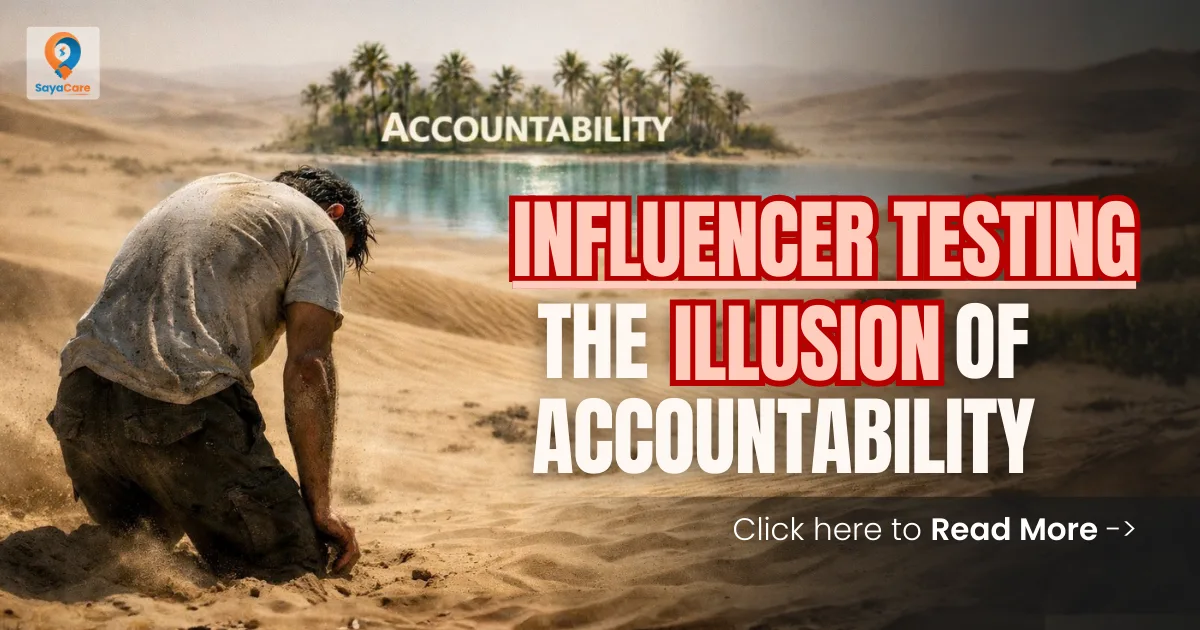
In this void of trust, a plethora of influencer offer the illusion of accountability. Influencers like: Trustified with Protein Powder, Nitin Joshi with Sunscreen, and most recently LiverDoc with Medicine. In such a low trust country, many believe these individuals are bringing accountability to a system so desperate for it. These herculean efforts are but a mirage. Read this blog to understand why influencer testing is not as reliable as it appears.
Table of Contents
How To Create Accountability?
As a founder in India, my primary job is creating systems and accountability for other individuals to properly function. These are my five pillars of accountability:
Consistency: If I confront an individual, but do not repeatedly follow up – then the behavior is changed for a brief period of time. The moment I get distracted elsewhere, they revert to their original behavior.
Upwards Transparency: I need to have complete ability to view the work that is done by that individual.
Knowledge: I need to know how long a task should be taken.
Consequences: You will be fired.
Integrity: Accountability should come from the work not getting done as opposed to any personal vendetta.
What About Influencers?
Knowledge: How much do digital influencers actually know what they are talking about?
Consistency: One off testing might generate outrage. But the rage lasts as long as attention spans, and those are dropping – fast!
Transparency: Different Influencers have different levels of transparency. (i) Who is the lab? Why should we trust them? (ii) How do we trust your sampling? How is it appropriately randomized or powered? (iii) How honest is the influencer?
Consequences: What occurs as a consequence of bad behavior – for either the influencer or the brand?
Integrity: Depends on individual to individual.
Top 3 Case Studies on Influencer Testing
Case Study 01: Trustified
Trustified is an influencer who started testing protein powder, and his subsequent popularity resulted in his branching out to other products. Trustified tests one random sample of a bunch of products, and the clear chits are clear chits. With many random internet denizens claiming to only trust products if they are Trustified cleared.
This is the equivalent of reading one peaceful man’s mind and declaring that all of humanity is transcendent.
Suppose a company has thousands of batches –
What if the sample that was taken was the one good batch they made in a thousand?
What if it was the only bad batch?
What if the batch went bad in storage?
What if they knew it would be tested and provided the correct sample for the batch?
What if the influencer is compromised? For an influencer who brags about getting notices from corporates, there was no disclosure as to why the Jan Aushadhi Multi-Vitamin Video was removed.
Suppose Trustified did catch a company who produces low quality goods. What then? What is the consequence?
Is Trustified’s testimony going to dramatically lower sales of any particular good or product? The influencer might have significant reach, but I doubt the impact will be that enormous. Suppose they do have significant reach, and the product was bad due to storage issues, then what? You damaged an entire company’s credibility. Suppose a vested interest has them display the results they desire?
Case Study 02: LiverDoc
LiverDoc is a hepatologist from South India who has made a reputation of railing against homeopathy and Ayurveda. He occasionally does community funded experiments. LiverDoc’s analysis of generic medicine had no statistical validity, seems over-priced for what he did, and is completely contrary to tons of evidence that has repeatedly been shown before him. His declarations ignore all previous history, and incidentally promote and denigrate a particular generic brand (Generic Aadhaar). It ignores all the other variables that make up testing or the large ecosystem that surrounds it. The speed with which other influencers came up with videos indicate a pushed narrative.
When I worked in Political PR: When working in a Washington D.C, Indian Think Tank, and under a few American Politicians, I was regularly exposed to manufactured narratives. Pay for 100 tweets, push media, journalists, etc to all publish the same thing at the same time. Suddenly it appears that everyone is talking about it, and the discussion arose organically. It is never organic. If you see a Scam Video come out, with hundreds of side videos coming out within a day – it is a pushed narrative.
Case Study 03: Nitin Joshi
Nitin Joshi tested several sunscreen brands and some work, and some failed. The narrative agenda was highlighted in the following thread:
His tests aren’t available online, and he apparently spent 5 lakhs out of pocket for these tests.
Out of the pillars of accountability, Knowledge and Consistency are close to non-existent, making influencer accountability loud but structurally hollow.
Opinion Time
I don’t know any of these influencers personally, I cannot speak to their personalities. However, I have met enough famous and important people to know that public persona and their real life personality can be the night and day. Think of Ellen DeGeneres – Beloved American TV Host who was an absolute Rakshas to her staff and guests off-screen. Personalities displayed solely over a screen can be carefully crafted to fit a particular narrative. That honest individual you see, can be little more than a paid spokesman speaking on behalf of a collection of narratives.
Thus, the knowledge and consistency to be conducting tests by influencers is non-existent.
Transparency
Is being visible on the screen the same as being transparent? If that’s the case, than Donald Trump is the most transparent person alive. Some would argue that transparency is having a large amount of information available up-front, and being available for answers when they arise. But real transparency comes from the individual. Ask me questions, and I will answer in depth. Ask questions that aren’t liked by these individuals, and they will ignore if they can. You could say they have a flood of comments, but there are few commentaries that actually build upon the work, and are solid questions. I’d focus on those if I was aiming at transparency.
But this isn’t the transparency I speak of either.
Transparency is like transparency in the work I assign. It has a structure, and a rhythm that’s well known and agreed upon. Structural transparency is when you know what these individuals do and how they do it. If asked to replicate it, you just need to follow procedure. For example, SayaCare tests each a sample of each and every unique batch that comes into our warehouse. That’s it. So simple a toddler could understand.
I won’t claim any manufacturer or any marketer is safe, because I don’t have the data to make that claim. I can only claim, what I’ve tested, what I’ve tested follows this structure.
Consequence
There is no consequence to failing to an influencer test. There is little consequence to failing our tests apart from we won’t do business with you no more. The only one capable of actually enforcing any true consequence is the government, and that – that’s a whole other beast.
Conclusion
Influencer Testing gives the populace the belief that there is someone holding truth to power. Unfortunately, that someone needs to be capable of consistent & knowledgeable, operating in a well-defined system with consequences of failure. None of the influencers meet any of these criterion.
SayaCare meets three out of four, but we have no consequence. Hence we cannot change anything, but our own supply.
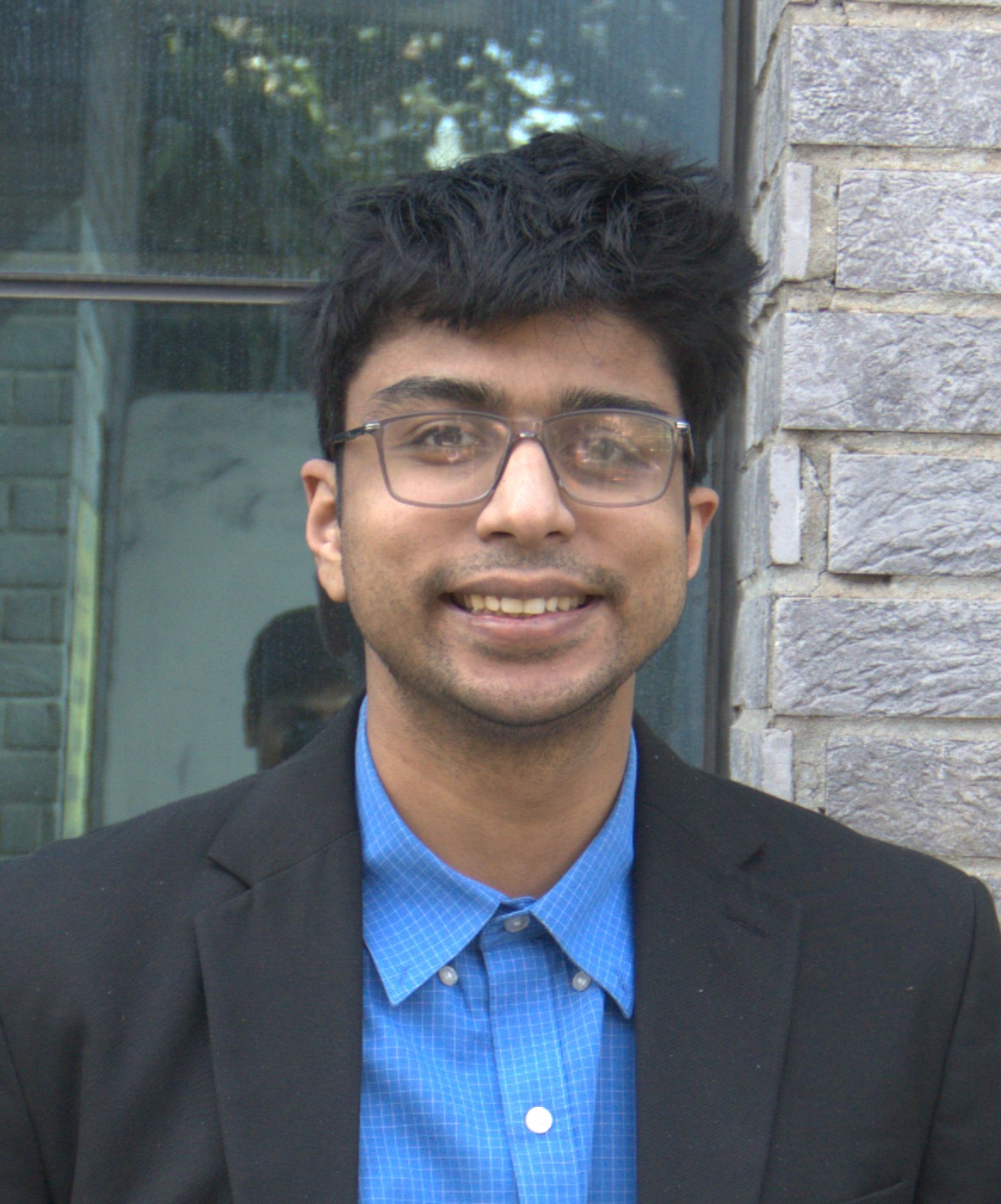
Dhruv Gupta founded SayaCare in 2021. Born and educated in the United States, Dhruv Gupta has several economics papers, public-health papers, and patents. He worked as an assistant to a Health Economic Advisor to the Prime Minister – where he frequently worked with and alongside Niti Aayog in formulating health policies for the country.
His work focuses on: Drug Prices, Nutrition, Air Pollution, Healthcare Human Resources, Health Education, Nursing, Drug Quality. He has a patent in a novel method of air-purification known as dual-sided filtration
Dhruv Gupta founded SayaCare in 2021. Born and educated in the United States, Dhruv Gupta has several economics papers, public-health papers, and patents. He worked as an assistant to a Health Economic Advisor to the Prime Minister – where he frequently worked with and alongside Niti Aayog in formulating health policies for the country.
His work focuses on: Drug Prices, Nutrition, Air Pollution, Healthcare Human Resources, Health Education, Nursing, Drug Quality. He has a patent in a novel method of air-purification known as dual-sided filtration