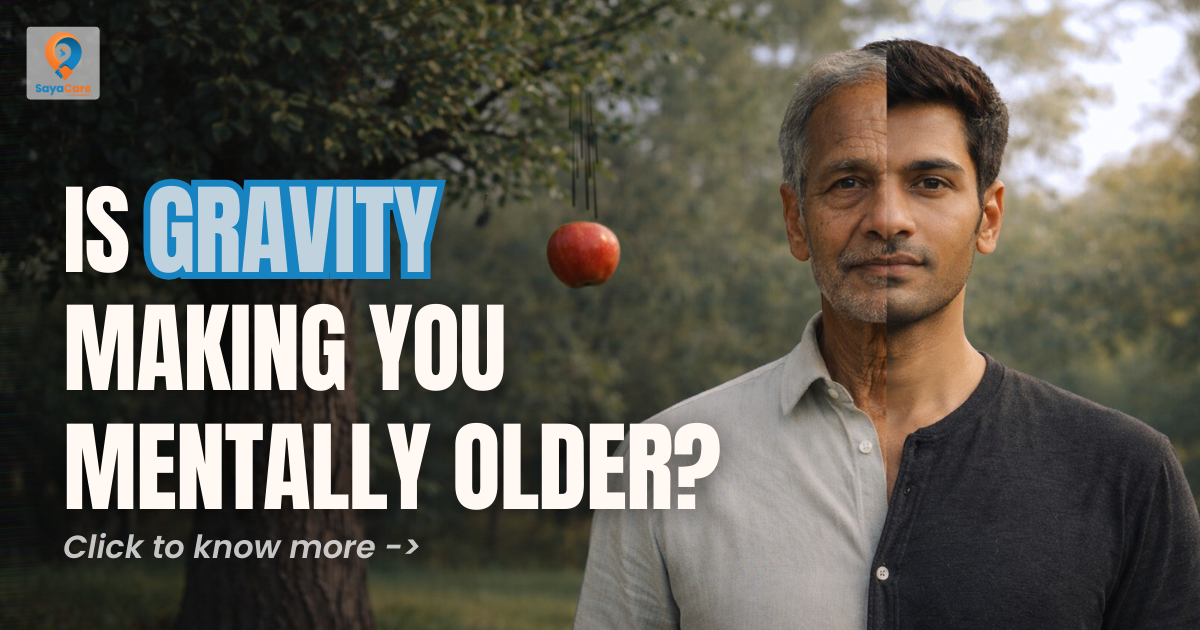
It began with a small, unfamiliar device. When Deepinder Goyal appeared on Raj Shamani’s podcast in mid-November 2025, viewers were quick to notice a platinum-like object attached near his temple. It looked clinical and out of place, briefly distracted from the conversation. Then came the claim. Goyal suggested that gravity, might be playing a role in how we age by slowly pulling blood away from brain and accelerating ageing.
The clip spread fast. Social media filled with speculation, debates and curiosity. Could gravity really be harming our brains? Was ageing partly a problem of blood flow? And what exactly was that device measuring?
This blog does not aim to debunk or defend the claim outright. Instead, it asks a more grounded question: when we step away from the buzz, what does science actually tell us about gravity, blood flow, and cognitive ageing?
Table of Contents
What Exactly Is Deepinder Goyal Claiming?
A few days after the podcast, Goyal put his idea into clearer words.
On 15 November 2025, he linked gravity to cognitive ageing through reduced blood flow to the brain. The claim was framed as a hypothesis, not a conclusion. According to the idea, even minor drops in blood flow to the brain, repeated daily while sitting or standing, could slowly add up and influence brain function over the years.
The device seen near his temple was part of this line of thought. It was described as a tool to monitor blood flow to the brain across different postures. Around the same time, Goyal introduced a research initiative called Continuous Research, which he said was studying what he called the “Gravity Ageing Hypothesis.”
On social media, he expanded the idea further, linking gravity to conditions such as hypertension, vascular disease, Alzheimer’s, and even questions about human ageing on Mars. The suggestion was simple but unsettling. If gravity alters blood flow to the brain, it may also influence how the brain ages.
To see whether this idea stands up, it helps to first understand what the Gravity Ageing Hypothesis actually claims.
What is Gravity Aging Hypothesis?
The Gravity Ageing Hypothesis rests on one central idea. The brain plays a key role in regulating how the body ages, and gravity may quietly interfere with that process.
According to Continuous Research, spending most of the day upright allows gravity to pull blood away from the brain. Even small, repeated reductions in cerebral blood flow are thought to matter over time, especially as the brain’s ability to compensate weakens with age.
In this view, ageing begins in the brain. As blood flow declines, other systems are said to follow. It is a clean explanation. Which is exactly why it needs closer scrutiny.
Is Gravity really responsible for cognitive aging?
If gravity really is ageing our brains, the clearest place to look would be where gravity changes. Scientists have done that. In one small study from Japan, researchers studied what happens to the brain when the body’s position changes?
Nine healthy young men were tested while lying flat, tilted head-up, and tilted head-down. If gravity mattered as much as the hypothesis suggests, blood flow to the brain should have shifted noticeably, but it didn’t. Despite the changes in posture, the brain kept its blood supply steady. Internal pressure adjustments and blood vessel regulation did the heavy lifting, quietly compensating for gravity’s pull.
A second experiment pushed the idea further. At the German Aerospace Center, researchers recreated conditions similar to space. Twenty four healthy adults lived through simulated microgravity, the kind astronauts experience. Scientists then added short daily doses of artificial gravity to see if it would protect thinking and coordination, but it didn’t. Cognition and sensory function stayed the same. Space itself offers another clue. In zero gravity, blood moves toward the head, not away from it. Pressure inside the skull increases. Yet astronauts do not return sharper or mentally younger.
In fact, many experience vision and neurological problems. The brain’s response to pressure is complex, and it does not reward either extreme. Back on Earth, long-term data tells a quieter story. In the English Longitudinal Study of Ageing, nearly 3,000 adults were followed over time. Many developed high blood pressure as they aged, and cognitive decline often followed. The pattern points toward vascular health rather than gravity alone.
Taken together, the evidence suggests something important. The brain is not a helpless organ slowly drained by gravity. It adapts, compensates, and regulates. When cognition declines, the causes are likely layered, involving blood vessels, lifestyle, and health, not just the force that keeps us on the ground.
Did Our Ancestors Understand Gravity and How to Deal With It?
Long before gravity was explained in scientific terms, people were already shaping their lives around how the body moves and balances. In India, gravity was described by Brahmagupta in the seventh century. Centuries earlier, practices attributed to Patanjali focused on posture, balance, and breath. Hatha yoga emerged from this tradition, not to defy gravity, but to work with it through controlled movement.
Modern research mirrors this idea. Studies of long-term hatha yoga practitioners show better attention and faster mental processing compared to non-practitioners. In one study involving older adults, those who practiced yoga regularly outperformed a control group on cognitive tasks. Another study examining attention, memory, and reasoning found similar improvements.
What stands out is not yoga itself, but what yoga represents. Regular movement. Changes in posture. Time spent upright, bent, inverted, and balanced. All of it keeps blood moving and the brain engaged. The same pattern appears outside yoga.
Exercise studies comparing moderate continuous training with high-intensity workouts show that both improve executive function. But moderate, sustained exercise often delivers stronger benefits, along with better blood flow to the brain. None of this suggests that our ancestors knew about cerebral blood flow or ageing in scientific terms. But they understood something practical. The body does better when it moves. The brain follows.If gravity has any role in how we age, it seems less like an enemy to fight and more like a force to work with.
What Happens When Scientific Curiosity Meets Public Spectacle
As I spent more time reading about Deepinder Goyal’s claim, it began to feel more like a scientific curiosity rather than a proven finding. Curiosity is a good place to begin, but what bothered me was how confidently the idea was shared in public, without clear studies or references to support it.
Once ideas like this leave research spaces and enter everyday conversations, they take on a life of their own. I saw this happen in small ways while talking to colleagues. The claim spread quickly, and along the way, people began drawing their own conclusions.
Some of those interpretations stayed with me:
1- No Need to Exercise:
A few people felt that if gravity itself drives ageing, then lifestyle choices might not matter as much. In a country already struggling with diabetes and physical inactivity, this kind of thinking can quietly push people further away from movement.
2- Living Longer by Hanging Upside Down:
Goyal spoke about bats living longer because they hang upside down. But nature is not that simple. Animals like the bowhead whale and the Greenland shark live far longer without doing anything of the sort. Long life cannot be reduced to posture alone.
3- Reduced Gravity Weakens the Body:
We already know that lower gravity leads to loss of muscle and bone strength. Astronauts experience this clearly, and even people living at high altitudes show similar patterns. Less gravity does not automatically mean a healthier body.
It also became clear that the device was not just about testing an idea. Appearing on a popular podcast with a sensor attached to his temple was bound to create hype. The focus shifted from existing scientific understanding to a dramatic visual moment.
A friend put it bluntly during one of our discussions. “These are tantrums only rich people can afford.” That reaction was not isolated. Much of the conversation online, especially on Reddit, echoed the same feeling. People questioned why attention was being pulled away from well-established health problems like inactivity, poor diet, stress, and sleep deprivation.
New ideas matter, but when presented with spectacle, they risk becoming distractions. The real danger is not curiosity itself, but how easily it can shift focus away from problems science has already worked hard to understand.
Conclusion
Gravity has been part of human life since the start. If it truly had such a strong effect on how our brain age, we would see its effects far more clearly in everyday life. How active we are. How well we sleep. What do we eat. How do we take care of our health. These are not new ideas, but they matter far more than dramatic theories.
New questions are important, but they need patience and proof. Gravity has never changed. The way we live within it has, and that is what shapes how we age.
Mahak Phartyal completed her bachelor's in pharmacy from Veer Madho Singh Bhandari Uttarakhand Technical University. She previously worked as a Medical Writer at Meril Life Sciences, where she wrote numerous scientific abstracts for conferences such as India Live 2024 and the European Society of Cardiology (ESC). During her college years, she developed a keen research interest and published an article titled “Preliminary Phytochemical Screening, Physicochemical and Fluorescence Analysis of Nyctanthes arbor-tristis and Syzygium cumini Leaves.”
Mahak Phartyal completed her bachelor’s in pharmacy from Veer Madho Singh Bhandari Uttarakhand Technical University. She previously worked as a Medical Writer at Meril Life Sciences, where she wrote numerous scientific abstracts for conferences such as India Live 2024 and the European Society of Cardiology (ESC). During her college years, she developed a keen research interest and published an article titled “Preliminary Phytochemical Screening, Physicochemical and Fluorescence Analysis of Nyctanthes arbor-tristis and Syzygium cumini Leaves.”