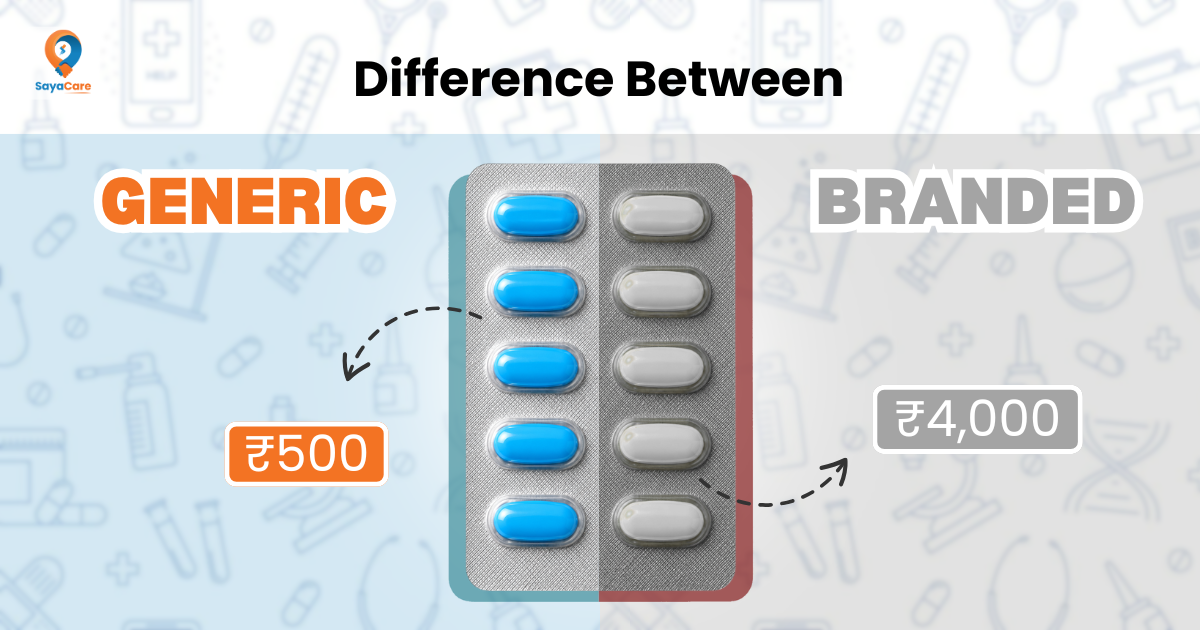
When your doctor prescribes an expensive branded medicine, do you ever wonder if there’s a cheaper alternative available? The answer is Generic medicines. The main difference between branded and generic medicines is usually the price and branding, while the active ingredient and intended effect remain the same. India supplies generic medicines of around 20% of world’s generic medicines and manufacture nearly 60,000 generic medicines across 60 different class of medicines [1].
Still, many people hesitate to choose generic medicines because they are unsure about their quality, safety, and effectiveness. Some believe that lower price means lower quality, while others simply trust branded medicines more because of familiarity.
In this blog, we will explain how branded and generic medicines work in simple words. By the end, you will have a clearer understanding of why you may not always need to pay 5 times more for branded medicines.
Table of Contents
What are Generic Medicines?
Generic medicines are cheaper because companies do not spend heavily on marketing and promotion, and the manufacturing monopoly is no longer limited to one company.
They contain the same active ingredients as branded medicines and are tested under the same regulatory standards, which is why they provide the same effectiveness and medical benefits.
What are Branded Medicines?
Branded medicines are essentially the same medicines but sold under a specific company or brand name. They are usually more expensive because pharmaceutical companies spend money on marketing, advertising, and brand promotion, and these costs are often passed on to customers.
Branded medicines are different from patented medicines, and they may not have been originally discovered or developed by the same company selling them under a brand name.
Difference between Branded and Generic Medicines
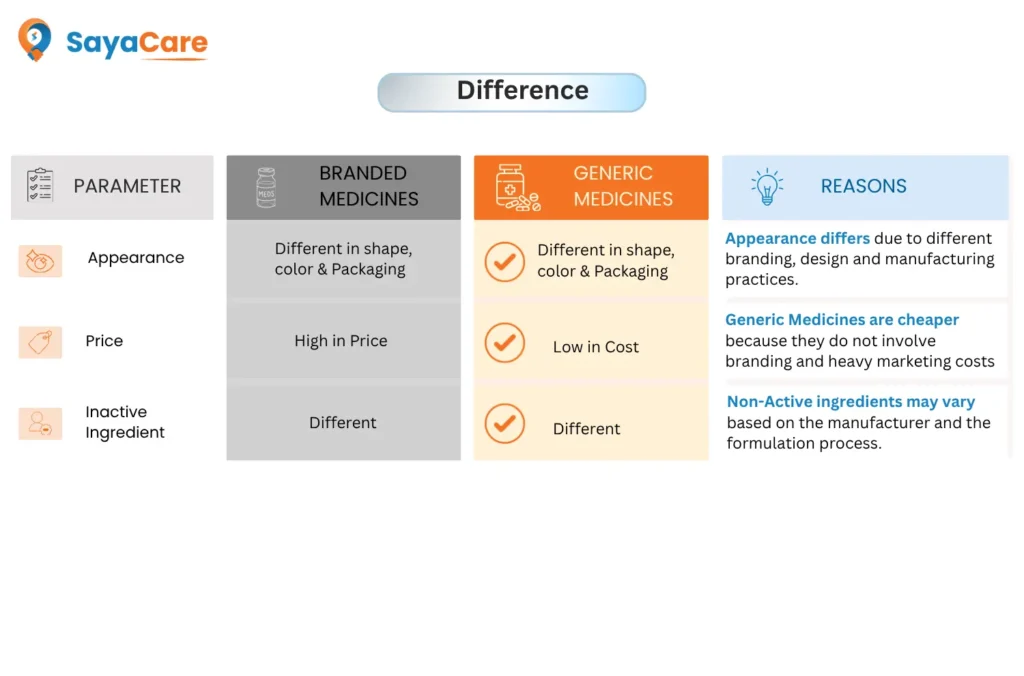
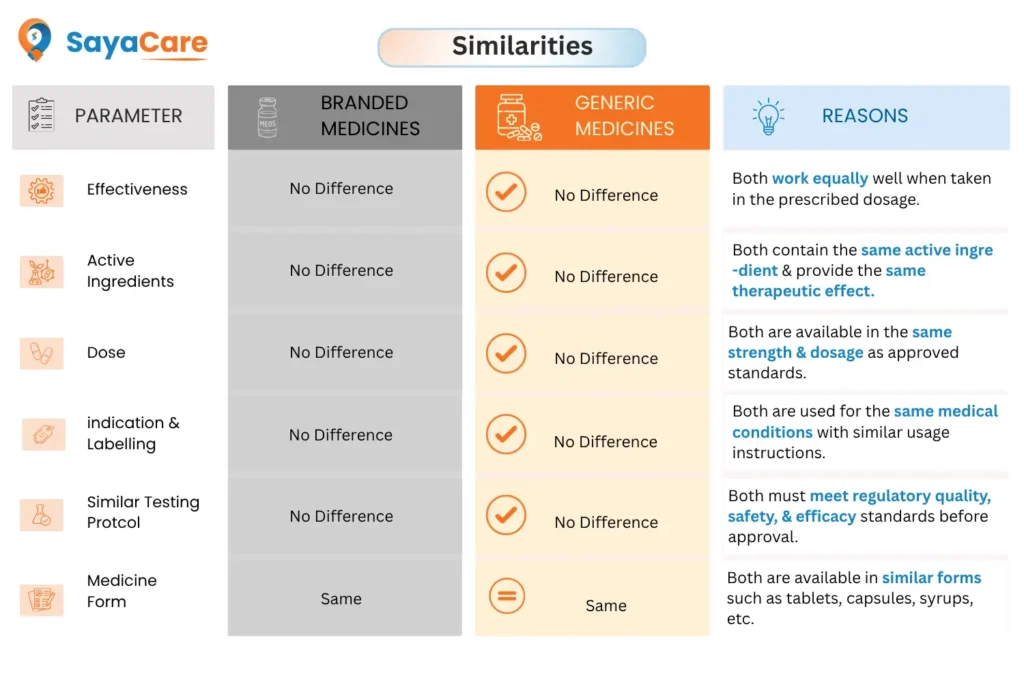
Branded and generic medicines differ mainly in three areas: price, inactive ingredients (excipients), and appearance. However, they are similar in many important ways, including effectiveness, active ingredients, dosage, medicine form, indication, labelling, and testing protocols.
In terms of effectiveness, branded and generic medicines work the same way and are expected to provide the same results. The main differences are usually related to how the medicine looks, what inactive ingredients are used, and how much it costs.
To understand this better, let’s look at the similarities and differences listed below:
FAQ’s
1- Why are Generic Medicines cheaper?
Generic medicines are cheaper because companies do not spend money on discovering the medicine or doing the initial research. They also spend less on marketing, advertising, packaging, and branding. Since many companies can manufacture them, competition also lowers the price.
2- Is Generic Medicines Effective?
Yes, generic medicines are equally effective because they contain the same active ingredients and follow the same safety and quality testing as branded medicines to ensure they provide the same medical benefits.
3- Is Generic Medicine Good?
Yes, generic medicines are safe, effective, and reliable. They provide the same medical benefits as branded medicines but at a much lower cost.
Mahak Phartyal completed her bachelor's in pharmacy from Veer Madho Singh Bhandari Uttarakhand Technical University. She previously worked as a Medical Writer at Meril Life Sciences, where she wrote numerous scientific abstracts for conferences such as India Live 2024 and the European Society of Cardiology (ESC). During her college years, she developed a keen research interest and published an article titled “Preliminary Phytochemical Screening, Physicochemical and Fluorescence Analysis of Nyctanthes arbor-tristis and Syzygium cumini Leaves.”
Mahak Phartyal completed her bachelor’s in pharmacy from Veer Madho Singh Bhandari Uttarakhand Technical University. She previously worked as a Medical Writer at Meril Life Sciences, where she wrote numerous scientific abstracts for conferences such as India Live 2024 and the European Society of Cardiology (ESC). During her college years, she developed a keen research interest and published an article titled “Preliminary Phytochemical Screening, Physicochemical and Fluorescence Analysis of Nyctanthes arbor-tristis and Syzygium cumini Leaves.”
1 thought on “What is The Difference Between Branded and Generic Medicines?”
A well-explained article about generic medicines and other medication options. Educating people about affordable and quality healthcare solutions is very important. Onlinegenericmedicine










A well-explained article about generic medicines and other medication options. Educating people about affordable and quality healthcare solutions is very important. Onlinegenericmedicine